
Fusion does not need extreme environments to exist. HYLENR enables nuclear interactions within engineered metal lattices that operate near controlled conditions and by using accessible materials. A fundamentally different approach to achieving energy.
These are not theoretical models.
They are results from working systems.

Lattice Confinement Fusion doesn't try to recreate the sun. It works differently — loading hydrogen isotopes into a solid metal lattice and using targeted excitation to trigger fusion reactions at manageable scales.
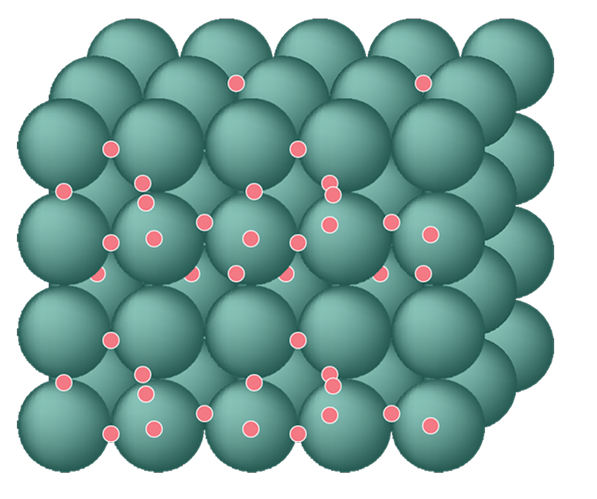
Hydrogen isotopes (deuterium) are absorbed into the palladium metal lattice at high density ratios. The lattice concentrates deuterons at nanoscale active environments (NAE) — cracks under 10 nm — creating unique quantum conditions for what follows. Strong screening effects begin to suppress the Coulomb barrier between nuclei.
Gamma-ray or photon stimulation triggers electron transitions at the nanoscale active environments. This excitation creates local electron screening effects that dramatically lower the Coulomb barrier — enabling sub-barrier quantum tunnelling events that would be vanishingly rare in free space.
Hydrogen nuclei within the lattice enter Coherent Correlated States (CCS) — a quantum mechanical regime where multiple deuterons act collectively. This coherence dramatically increases the probability of close nuclear approach and enables multinucleon interaction pathways not available in isolated particle collisions.
Dense charge clusters form as coherent electron-nuclei assemblies concentrate in nanoscale active sites. These clusters create extreme local charge density — effectively confining nuclear reactants in a region small enough for fusion interaction probabilities to become significant without requiring plasma temperatures of millions of degrees.
Within the charge cluster, multinucleon transfer reactions between hydrogen isotopes and the palladium host material trigger fusion-fission events. These pathways generate energy through nuclear binding energy release and the formation of new isotopes — including measurable transmutation products (uranium, yttrium).
The reaction chain produces two independently verifiable outputs: sustained excess heat beyond input energy, and new elemental transmutation products confirmed via EDX analysis. Both are nuclear — not chemical — signatures, validated across multiple independent experimental sets.
Hylenr's LCF reactors don't just produce heat — they synthesise elements. Experimental batches have consistently identified formation of new Elements in the host catalyst including Lighter, Heavier and Rare Earth Elements. Reactions are benchmarked against first-generation nuclear transitions to ensure reproducibility.

Verified presence of trace uranium formation in 4 independent experimental sets
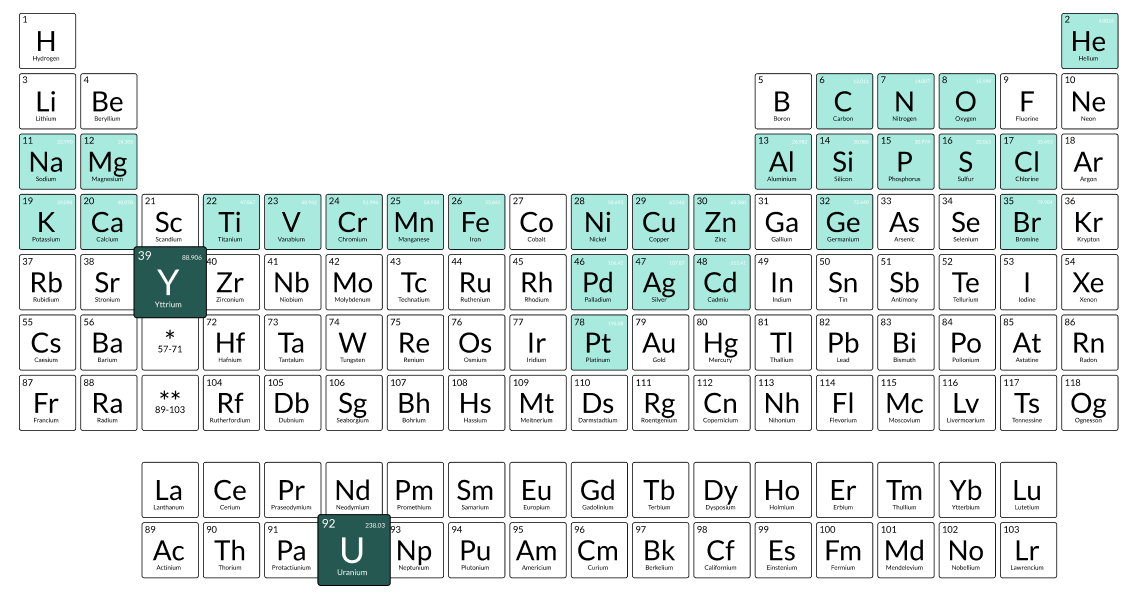
Yttrium production through selective oxidation or electron-reduced deposition. Synthesis via LCF in two independent experimental runs.
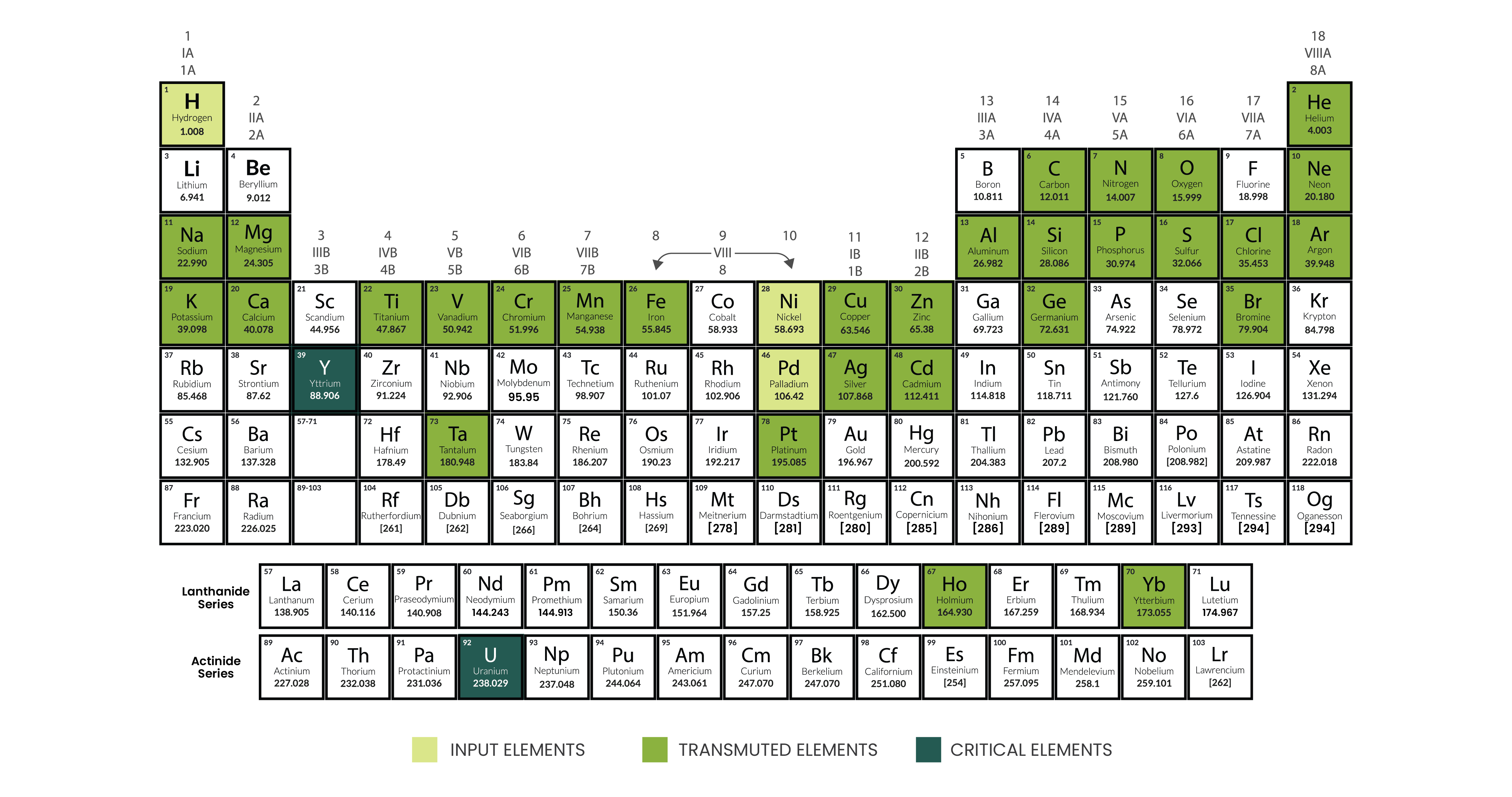
4 independent experimental sets. Consistent uranium formation on palladium catalyst surfaces via LCF.
In HYLENR reactors, uranium nuclei have been observed to form on palladium surfaces via multinucleon transfer and fusion pathways, enabling the synthesis of heavy elements at low energy without high neutron flux or radioactive precursors
2 independent experimental runs. Selective synthesis pathway confirmed via EDX spectrum analysis.
EDXAnalysis – Post Reaction Atomic CompositionYttriumproductionfrom palladium , likely through selective proton or deuteron-inducedtransmutation processes,demonstrating the ability of LENR to synthesize rare elements under controlled lattice confinement.
ICCF-27 Presentation: Agastya Rao presents experimental findings from a multi-channel independent study conducted at Texas A&M University. The research evaluates thermal performance, noble gas formation, and material transformations in hydrogen-loaded nickel-palladium reactors.
Four independent validation markers demonstrate that fusion reactions are occurring inside Hylenr's LCF reactors — measurable, reproducible, and independently verifiable.


Gas mass spectrometry of reactor residual gas confirms reaction byproduct signatures consistent with nuclear fusion events. Three independent series of reactor data showing excess gas.
Reactor output consistently exceeds electrical energy input — demonstrating excess heat that cannot be explained by chemical reactions alone. Measured across multiple experimental configurations.
Post-reaction EDX surface analysis identifies new elements — uranium and yttrium — formed on palladium catalyst surfaces. Repeated synthesis confirms nuclear, not chemical, origin.
Radiation measurements taken throughout and after reactor operation confirm no radioactive emissions. The LCF process remains within safe operating parameters — suitable for deployment in civilian and defence contexts.
Three distinct time-series datasets from reactor residual gas measurements independently confirm excess gas generation — a repeatable signature of ongoing nuclear reactions.
Independent validation markers demonstrate that fusion reactions are occurring inside Hylenr's LCF reactors — measurable, reproducible, and independently verifiable.

Hydrogen atoms are introduced into metal lattices such as palladium, creating a dense and structured environment for interaction.

Phonon dynamics within the lattice influence atomic behaviour; creating conditions where interactions become possible.
Under controlled conditions, the lattice-mediated reactions enable nuclear interactions beyond conventional thresholds.
The system produces measurable excess heat, which is a direct output of the reactions occurring within the lattice.
The fusion pathway in LCF is aneutronic it does not produce free neutrons, which are the primary source of radioactive contamination in conventional nuclear reactions.
Unlike plasma fusion (D-T reaction), Hylenr's reactions do not produce tritium the radioactive hydrogen isotope that requires complex handling, containment, and disposal.
The reaction occurs within a sealed solid-state metal lattice. There is no chain reaction mechanism, no critical mass, and no possible meltdown or explosion scenario.
Reaction products are stable, non-radioactive isotopes and light elements — including helium, yttrium, and trace transmutation byproducts — none requiring special disposal.

Office Address
Hylenr Technologies Private Limited
IIIT Hyderabad – Vindhya C4, CIE
Hylenr INC
100 Engelwood Dr, Suite F
Orion Township, MI 48359
United States
.png)
.svg)


